Neodymium
Soft bright silvery metallic element, belongs to the lanthanoids. Seven natural isotopes, Nd-144 being the only radioactive one with a half-life of 10^10 to 10^15 years. Six artificial radioisotopes have been produced. The metal is used in glass works to color class a shade of violet-purple and make it dichroic. One of the more reactive rare-earth metals, quickly reacts with air. Used in some rare-earth alloys. Neodymium is used to color the glass used in welder's glasses. Neodymium is also used in very powerful, permanent magnets (Nd2Fe14B). Discovered by Carl F. Auer von Welsbach in Austria in 1885 by separating didymium into its elemental components Praseodymium and neodymium. The name comes from the Greek words 'neos didymos' which means 'new twin'. Neodymium should be considered highly toxic, however evidence would seem to show that it acts as little more than a skin and eye irritant. The dust however, presents a fire and explosion hazard.
Gallery

Hi-Res Images ofChemical Elements, CC BY 3.0 <https://creativecommons.org/licenses/by/3.0>, via Wikimedia Commons, source: https://images-of-elements.com/neodymium.php
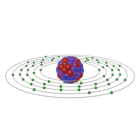
Physical Propertiesmass · density · phase · crystal
Atomic Mass
144.2420Da
Density
7.0100g/cm³
Phase (STP)
Solid
Melting Point
1289.2K
Boiling Point
3347.2K
Molar Heat
0.1900J/(mol·K)
Crystal Structure
HEX
Lattice Constant
3.660Å
Atomic Radiiatomic · covalent · van der Waals
Atomic (Empirical)
185.00pm
Covalent
174.00pm
Van der Waals
239.00pm
Electronic Propertieselectronegativity · ionization · affinity
Electron Configuration
[Xe] 4f4 6s2
Electron Shells
2, 8, 18, 22, 8, 2
Electronegativity
1.14Pauling
Electron Affinity
1.9kJ/mol
1st Ionization Energy
5.5kJ/mol
Oxidation States
+2, +3
Orbital DiagramAufbau · Hund's rule · Pauli exclusion
Full: 1s2 2s2 2p6 3s2 3p6 3d10 4s2 4p6 4d10 5s2 5p6 4f4 6s2Short: [Xe] 4f4 6s2
Ionization Energies (60 known)
Emission Spectrumvisible range · characteristic spectral lines
Abundanceby mass
Log scale · ppm = parts per million by mass
Biological Role
No known biological role. Low toxicity.
Discovery
Discovered By
C.F. Aver von Welsbach
Named By
—
Year
1925
Nuclear Data
Known Isotopes
40
Stable Isotopes
5
Stable Mass Numbers
142, 143, 145, 146, 148
Natural isotopic abundance (IUPAC recommended values)
Isotopes of Nd40 known
| Nuclide | Z | N | Mass (AMU) | Half-life | Decay | Jπ | Abundance |
|---|---|---|---|---|---|---|---|
| 124Nd | 60 | 64 | 123.951873 | Unknown | β⁺, β⁺p | 0+ | — |
| 125Nd | 60 | 65 | 124.948395 | 650 ms | β⁺ (1%), β⁺p (0%) | 5/2 | — |
| 126Nd | 60 | 66 | 125.942694 | Unknown | β⁺, β⁺p | 0+ | — |
| 142Ndstable | 60 | 82 | 141.907729 | Stable | stable (1%) | 0+ | 2715.3000% |
| 143Ndstable | 60 | 83 | 142.909820 | Stable | stable (1%) | 7/2- | 1217.3000% |
| 144Nd | 60 | 84 | 143.910093 | 2290000 Gy | α (1%) | 0+ | 2379.8000% |
| 145Ndstable | 60 | 85 | 144.912579 | Stable | α | 7/2- | 829.3000% |
| 146Ndstable | 60 | 86 | 145.913122 | Stable | 2β⁻, α | 0+ | 1718.9000% |
| 148Ndstable | 60 | 88 | 147.916899 | Stable | 2β⁻, α | 0+ | 575.6000% |
| 150Nd | 60 | 90 | 149.920901 | 9300000000 Gy | 2β⁻ (1%) | 0+ | 563.8000% |
| 161Nd | 60 | 101 | 160.954664 | 215 ms | β⁻ (1%), β⁻n | 1/2- | — |
| 162Nd | 60 | 102 | 161.958121 | 310 ms | β⁻ (1%) | 0+ | — |
| 163Nd | 60 | 103 | 162.963414 | Unknown | β⁻, β⁻n | 5/2- | — |