Lutetium
Silvery-white rare-earth metal which is relatively stable in air. It happens to be the most expensive rare-earth metal. Its found with almost all rare-earth metals, but is very difficult to separate from other elements. Least abundant of all natural elements. Used in metal alloys, and as a catalyst in various processes. There are two natural, stable isotopes, and seven radioisotopes, the most stable being Lu-174 with a half-life of 3.3 years. The separation of lutetium from Ytterbium was described by Georges Urbain in 1907. It was discovered at approximately the same time by Carl Auer von Welsbach. The name comes from the Greek word lutetia which means Paris.
Gallery
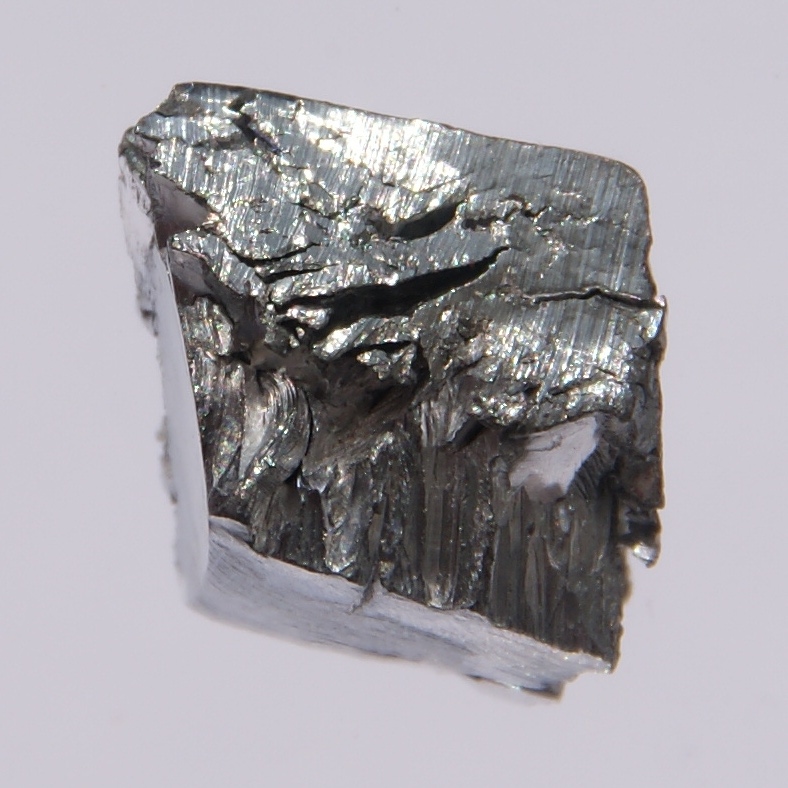
Jurii, CC BY 3.0 <https://creativecommons.org/licenses/by/3.0>, via Wikimedia Commons, source: https://images-of-elements.com/lutetium.php
Physical Propertiesmass · density · phase · crystal
Atomic Mass
174.9668Da
Density
9.8400g/cm³
Phase (STP)
Solid
Melting Point
1936.2K
Boiling Point
3675.2K
Molar Heat
0.1540J/(mol·K)
Crystal Structure
HEX
Lattice Constant
3.510Å
Atomic Radiiatomic · covalent · van der Waals
Atomic (Empirical)
175.00pm
Covalent
162.00pm
Van der Waals
224.00pm
Electronic Propertieselectronegativity · ionization · affinity
Electron Configuration
[Xe] 4f14 5d 6s2
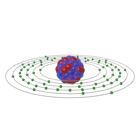
Electron Shells
2, 8, 18, 32, 9, 2
Electronegativity
1Pauling
Electron Affinity
0.3kJ/mol
1st Ionization Energy
5.4kJ/mol
Oxidation States
+3
Orbital DiagramAufbau · Hund's rule · Pauli exclusion
Full: 1s2 2s2 2p6 3s2 3p6 3d10 4s2 4p6 4d10 5s2 5p6 4f14 5d1 6s2Short: [Xe] 4f14 5d 6s2
Ionization Energies (71 known)
Emission Spectrumvisible range · characteristic spectral lines
Abundanceby mass
Log scale · ppm = parts per million by mass
Biological Role
No known biological role. Lu-177 used in cancer radiotherapy.
Discovery
Discovered By
Georges Urbain
Named By
—
Year
1907
Nuclear Data
Known Isotopes
39
Stable Isotopes
1
Stable Mass Numbers
175
Natural isotopic abundance (IUPAC recommended values)
Isotopes of Lu39 known
| Nuclide | Z | N | Mass (AMU) | Half-life | Decay | Jπ | Abundance |
|---|---|---|---|---|---|---|---|
| 150Lu | 71 | 79 | 149.973407 | 45.0 ms | p (1%), β⁺ | 5- | — |
| 151Lu | 71 | 80 | 150.967471 | 78.4 ms | p, β⁺ | 11/2- | — |
| 152Lu | 71 | 81 | 151.964120 | 650 ms | β⁺ (1%), β⁺p (0.15%) | 4- | — |
| 175Lustable | 71 | 104 | 174.940777 | Stable | stable (1%) | 7/2+ | 9740.1000% |
| 176Lu | 71 | 105 | 175.942692 | 37.0 Gy | β⁻ (1%), β⁺ (0.0045000000000000005%) | 7- | 259.9000% |
| 186Lu | 71 | 115 | 185.967450 | Unknown | β⁻, β⁻n | — | — |
| 187Lu | 71 | 116 | 186.970188 | Unknown | β⁻ | 7/2+ | — |
| 188Lu | 71 | 117 | 187.974428 | Unknown | β⁻, β⁻n | — | — |