Molybdenum
Silvery-white, hard metallic transition element. It is chemically unreactive and is not affected by most acids. It oxidizes at high temperatures. There are seven natural isotopes, and four radioisotopes, Mo-93 being the most stable with a half-life of 3500 years. Molybdenum is used in almost all high-strength steels, it has nuclear applications, and is a catalyst in petroleum refining. Discovered in 1778 by Carl Welhelm Scheele of Sweden. Impure metal was prepared in 1782 by Peter Jacob Hjelm. The name comes from the Greek word molybdos which means lead. Trace amounts of molybdenum are required for all known forms of life. All molybdenum compounds should be considered highly toxic, and will also cause severe birth defects.
Gallery
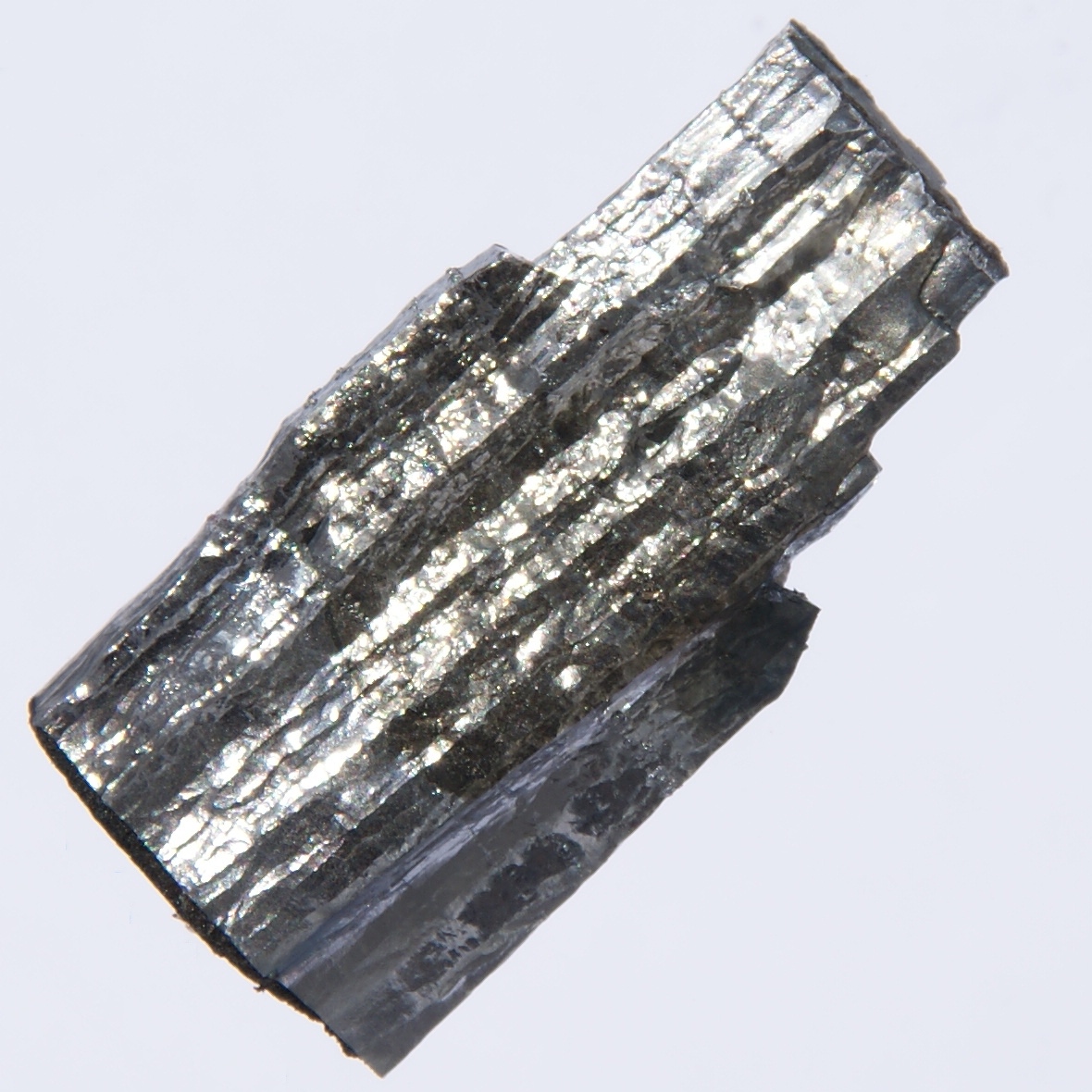
Jurii, CC BY 3.0 <https://creativecommons.org/licenses/by/3.0>, via Wikimedia Commons, source: https://images-of-elements.com/molybdenum.php

Physical Propertiesmass · density · phase · crystal
Atomic Mass
95.9500Da
Density
10.2000g/cm³
Phase (STP)
Solid
Melting Point
2895.2K
Boiling Point
4912.1K
Molar Heat
0.2510J/(mol·K)
Crystal Structure
BCC
Lattice Constant
3.150Å
Atomic Radiiatomic · covalent · van der Waals
Atomic (Empirical)
145.00pm
Covalent
138.00pm
Van der Waals
217.00pm
Electronic Propertieselectronegativity · ionization · affinity
Electron Configuration
[Kr] 4d5 5s
Electron Shells
2, 8, 18, 13, 1
Electronegativity
2.16Pauling
Electron Affinity
0.7kJ/mol
1st Ionization Energy
7.1kJ/mol
Oxidation States
-4, -2, -1, 0, +1, +2, +3, +4, +5, +6
Orbital DiagramAufbau · Hund's rule · Pauli exclusion
Full: 1s2 2s2 2p6 3s2 3p6 3d10 4s2 4p6 4d5 5s1Short: [Kr] 4d5 5s
Ionization Energies (42 known)
Emission Spectrumvisible range · characteristic spectral lines
Abundanceby mass
Log scale · ppm = parts per million by mass
Biological Role
Cofactor in xanthine oxidase, sulfite oxidase, and aldehyde oxidase enzymes.
Discovery
Discovered By
Carl Wilhelm Scheele
Named By
—
Year
1778
Nuclear Data
Known Isotopes
39
Stable Isotopes
6
Stable Mass Numbers
92, 94, 95, 96, 97, 98
Natural isotopic abundance (IUPAC recommended values)
Isotopes of Mo39 known
| Nuclide | Z | N | Mass (AMU) | Half-life | Decay | Jπ | Abundance |
|---|---|---|---|---|---|---|---|
| 81Mo | 42 | 39 | 80.966226 | Unknown | β⁺, β⁺p | 5/2+ | — |
| 82Mo | 42 | 40 | 81.956661 | Unknown | β⁺, β⁺p | 0+ | — |
| 83Mo | 42 | 41 | 82.950252 | 23.0 ms | β⁺ (1%), β⁺p | 3/2- | — |
| 92Mostable | 42 | 50 | 91.906807 | Stable | 2β⁺ | 0+ | 1464.9000% |
| 94Mostable | 42 | 52 | 93.905084 | Stable | stable (1%) | 0+ | 918.7000% |
| 95Mostable | 42 | 53 | 94.905837 | Stable | stable (1%) | 5/2+ | 1587.3000% |
| 96Mostable | 42 | 54 | 95.904675 | Stable | stable (1%) | 0+ | 1667.3000% |
| 97Mostable | 42 | 55 | 96.906017 | Stable | stable (1%) | 5/2+ | 958.2000% |
| 98Mostable | 42 | 56 | 97.905404 | Stable | 2β⁻ | 0+ | 2429.2000% |
| 100Mo | 42 | 58 | 99.907468 | 7070000000 Gy | 2β⁻ (1%) | 0+ | 974.4000% |
| 117Mo | 42 | 75 | 116.961686 | 22.0 ms | β⁻ (1%), β⁻n, 2n | 3/2+ | — |
| 118Mo | 42 | 76 | 117.965249 | 21.0 ms | β⁻ (1%), β⁻n, 2n | 0+ | — |
| 119Mo | 42 | 77 | 118.971465 | Unknown | β⁻, β⁻n, 2n | 3/2+ | — |