Oxygen
A colourless, odourless gaseous element belonging to group 16 of the periodic table. It is the most abundant element present in the earth's crust. It also makes up 20.8% of the Earth's atmosphere. For industrial purposes, it is separated from liquid air by fractional distillation. It is used in high temperature welding, and in breathing. It commonly comes in the form of Oxygen, but is found as Ozone in the upper atmosphere. It was discovered by Priestley in 1774.
Gallery

Staff Sgt. Nika Glover, U.S. Air Force, Public domain, via Wikimedia Commons

Emission spectrum
Physical Propertiesmass · density · phase · crystal
Atomic Mass
15.9990Da
Density
0.0013g/L
Phase (STP)
Gas
Melting Point
54.4K
Boiling Point
90.2K
Molar Heat
0.9180J/(mol·K)
Crystal Structure
CUB
Lattice Constant
6.830Å
Atomic Radiiatomic · covalent · van der Waals
Atomic (Empirical)
60.00pm
Covalent
63.00pm
Van der Waals
152.00pm
Electronic Propertieselectronegativity · ionization · affinity
Electron Configuration
[He] 2s2 2p4
Electron Shells
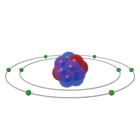
2, 6
Electronegativity
3.44Pauling
Electron Affinity
1.5kJ/mol
1st Ionization Energy
13.6kJ/mol
Oxidation States
-2, -1, +1, +2
Orbital DiagramAufbau · Hund's rule · Pauli exclusion
Full: 1s2 2s2 2p4Short: [He] 2s2 2p4
Ionization Energies (8 known)
Emission Spectrumvisible range · characteristic spectral lines
Abundanceby mass
Log scale · ppm = parts per million by mass
Biological Role
Required for cellular respiration. Most abundant element in the human body by mass.
Discovery
Discovered By
Joseph Priestly, Carl Wilhelm Scheele
Named By
—
Year
1774
Nuclear Data
Known Isotopes
18
Stable Isotopes
5
Stable Mass Numbers
16, 17, 18, 27, 28
Natural isotopic abundance (IUPAC recommended values)
Isotopes of O18 known
| Nuclide | Z | N | Mass (AMU) | Half-life | Decay | Jπ | Abundance |
|---|---|---|---|---|---|---|---|
| 11O | 8 | 3 | 11.051250 | Unknown | 2p (1%) | 3/2- | — |
| 12O | 8 | 4 | 12.034368 | 8.90 zs | 2p (1%) | 0+ | — |
| 13O | 8 | 5 | 13.024815 | 8.58 ms | β⁺ (1%), β⁺p (0.109%) | 3/2- | — |
| 16Ostable | 8 | 8 | 15.994915 | Stable | stable (1%) | 0+ | 9975.7000% |
| 17Ostable | 8 | 9 | 16.999132 | Stable | stable (1%) | 5/2+ | 3.8350% |
| 18Ostable | 8 | 10 | 17.999160 | Stable | stable (1%) | 0+ | 20.4500% |
| 26O | 8 | 18 | 26.037210 | 4.20 ps | 2n (1%) | 0+ | — |
| 27Ostable | 8 | 19 | 27.047955 | Stable | n, 2n | 3/2+ | — |
| 28Ostable | 8 | 20 | 28.055910 | Stable | 2n, β⁻ (0%) | 0+ | — |
Key Compoundscontaining O
H₂O
Water
The most abundant compound on Earth's surface and the universal solvent essential for all known life
CO₂
Carbon Dioxide
A linear triatomic molecule produced by combustion and respiration
CO
Carbon Monoxide
A colorless, odorless, poisonous gas
H₂O₂
Hydrogen Peroxide
A powerful oxidizer with an O–O single bond that decomposes to water and oxygen
O₃
Ozone
An allotrope of oxygen with three atoms forming a bent molecule with resonance structures
SO₂
Sulfur Dioxide
A bent molecule with resonance bonding
NO₂
Nitrogen Dioxide
A brown, toxic gas and key component of urban smog
NO
Nitric Oxide
A free radical signaling molecule in the body, regulating blood pressure, neurotransmission, and immune response
SiO₂
Silicon Dioxide
The main component of sand, quartz, and glass