Astatine
Radioactive halogen element. Occurs naturally from uranium and thorium decay. At least 20 known isotopes. At-210, the most stable, has a half-life of 8.3 hours. Synthesized by nuclear bombardment in 1940 by D.R. Corson, K.R. MacKenzie and E. Segre at the University of California.
Gallery
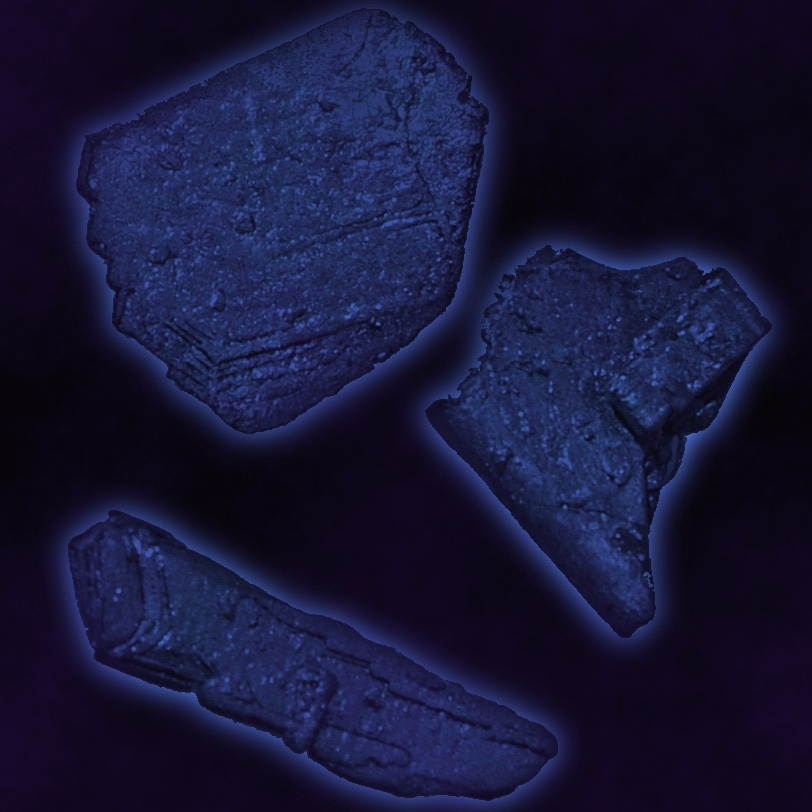
Chemical ELements A Virtual Museum, CC BY 3.0 <https://creativecommons.org/licenses/by/3.0> source: https://images-of-elements.com/astatine.php

Physical Propertiesmass · density · phase · crystal
Atomic Mass
210Da
Density
7g/cm³
Phase (STP)
Solid
Melting Point
575.1K
Boiling Point
—
Molar Heat
—
Crystal Structure
—
Atomic Radiiatomic · covalent · van der Waals
Atomic (Empirical)
—
Covalent
147.00pm
Van der Waals
202.00pm
Electronic Propertieselectronegativity · ionization · affinity
Electron Configuration
[Xe] 4f14 5d10 6s2 6p5
Electron Shells
2, 8, 18, 32, 18, 7
Electronegativity
2.20Pauling
Electron Affinity
2.8kJ/mol
1st Ionization Energy
9.3kJ/mol
Oxidation States
-1, +1, +3, +5, +7
Orbital DiagramAufbau · Hund's rule · Pauli exclusion
Full: 1s2 2s2 2p6 3s2 3p6 3d10 4s2 4p6 4d10 5s2 5p6 4f14 5d10 6s2 6p5Short: [Xe] 4f14 5d10 6s2 6p5
Ionization Energies (85 known)
Emission Spectrumvisible range · characteristic spectral lines
Abundanceby mass
Biological Role
Extremely rare and radioactive. No biological role.
Discovery
Discovered By
D.R.Corson, K.R.MacKenzie, E.Segré
Named By
—
Year
1940
Nuclear Data
Known Isotopes
39
Stable Isotopes
0
Stable Mass Numbers
None